
REVIEW · CASTRO HISTORY & LGBTQ+ WALKS
San Francisco : Mission and Castro districts tour in French
Rainbow flags meet street art fast. This small group French tour links two San Francisco neighborhoods, the Castro and the Mission District, with clear explanations of LGBT community history and how the city grew. The biggest win for me is the way the guide makes the stories easy to follow, even when the streets get busy.
I also love the mix of photo stops and real walking blocks, so you get both the landmarks and the everyday vibe, from Harvey Milk Plaza to murals on Mission walls. One consideration: it runs rain or shine, and you cover a fair amount of ground in about 3 hours, so wear shoes you can handle.
Key highlights to look forward to
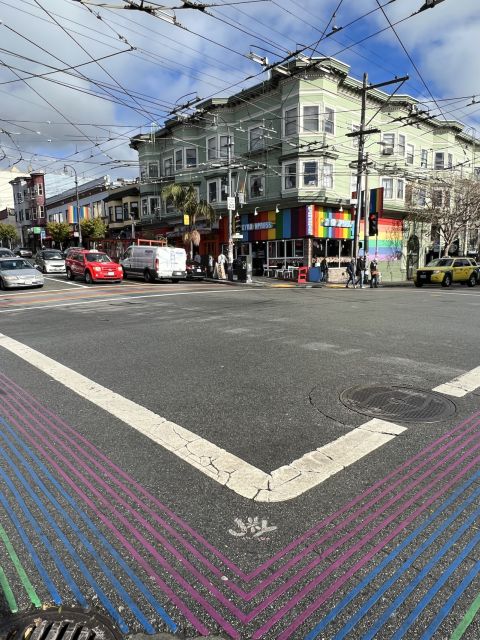
- Castro, in context: Rainbow Flag, Harvey Milk Plaza, Castro Theatre, and the former photo store linked to Harvey Milk
- Mission District essentials: Mission Dolores and the early-Hispanic roots you can feel in the streets
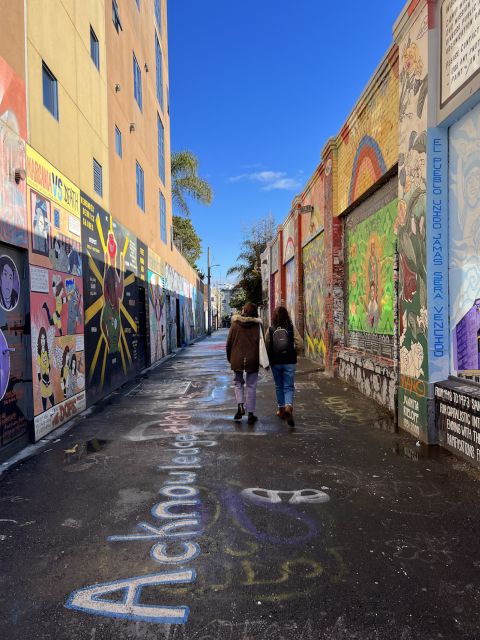
- Street art as a classroom: Women’s Building mural and Clarion Alley graffiti
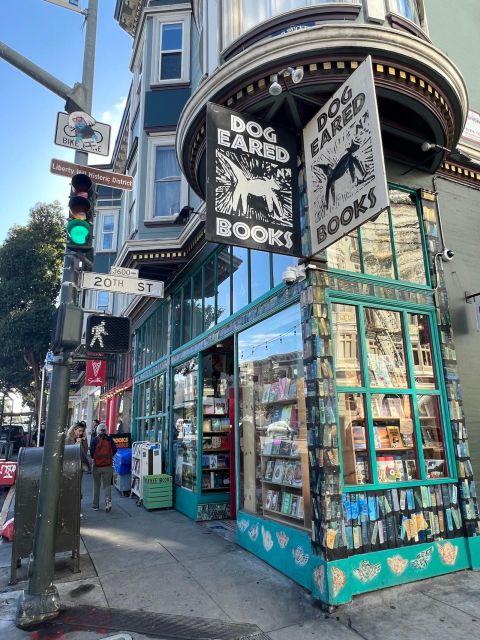
- Local browsing on Valencia Street: taquerias, thrift shops, and independent bookstores
- Architecture beyond the postcards: Victorian houses and Liberty Hill, including the John McMullen House
- A view payoff: the stop at the top of Dolores Park to wrap it up
Murals, taquerias and another walk through the Mission



Meeting at Cafe de Casa: how the French format really helps
The tour starts at Cafe de Casa, and from the first minutes you know what you are buying: a guided, French-language walk that keeps moving. The group stays small, up to 10 people, so you get real interaction instead of just standing near the front like a human traffic cone.
This matters because both neighborhoods are layered. The Castro is famous, but the Mission has its own older rhythm. A French-speaking guide keeps the thread straight, and you also get practical support: a map with the best addresses, plus an email after the visit that reminds you where you went and includes a souvenir photo.
I like that this tour is described as rain or shine. In San Francisco, that is a blessing. It also means you should bring a light rain layer, because you will be taking photos and stopping for short explanations.
Castro in 90 minutes: from the Rainbow Flag to Harvey Milk landmarks
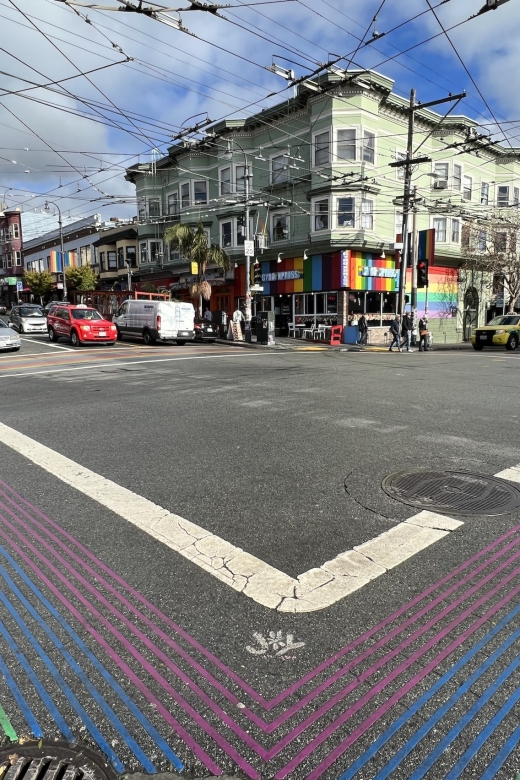
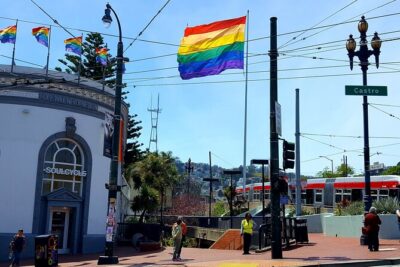
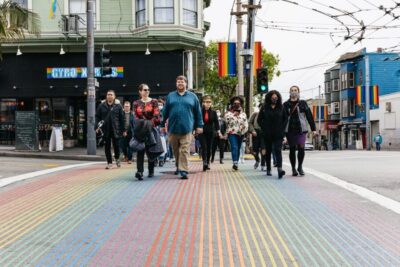
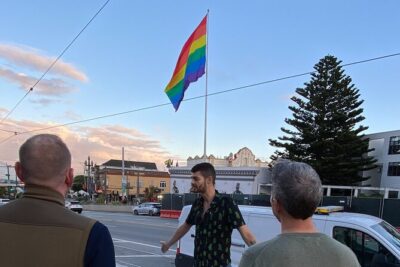
You start in the Castro, and the famous moment arrives quickly: the Rainbow Flag, the huge signal that you are in the heart of America’s first gay neighborhood. It is not just decoration. The tour uses it as the launch point for explaining how the area became a community center, not only a tourist stop.
Next comes Harvey Milk Plaza, where the guide connects the political story to the physical setting. Then you head toward the Castro Theatre, another landmark that helps you understand why the Castro felt like a place with its own pulse. One of the most memorable parts is the former photo store connected to Harvey Milk, often referenced as the place linked to him as one of the first openly gay elected officials. Seeing it in street context makes the history feel less like a lesson and more like a timeline you can walk along.
Practical note: this is where the streets can feel lively. If you want crisp photos, listen for the guide’s timing and step into position quickly. The tour includes photo stops, so you will not be rushed, but you also should not drift five steps behind the group.
Victorian houses and that Maxime le Forestier blue house moment
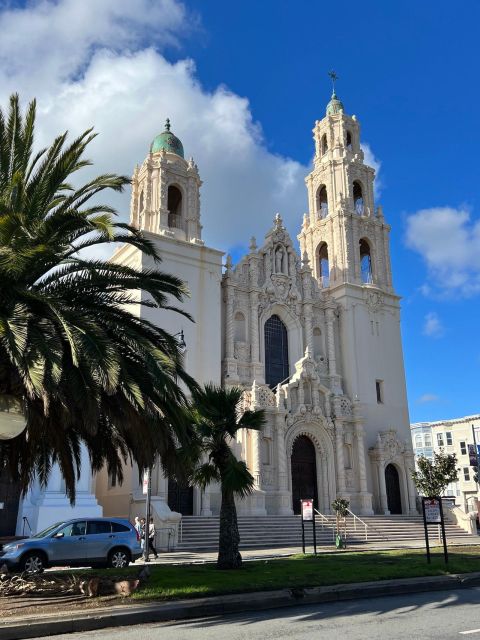
As the tour transitions toward the Mission District, you shift from the Castro’s “I know this place” fame into blocks where the architecture tells part of the story. The route includes stops where you can look closely at Victorian houses and street-level details, not just big signs.
One detail I really like is the mention of the blue house linked to Maxime le Forestier’s song. That kind of pop-culture reference works well here because it turns an abstract lyric into a literal street reality. Even if you are not the person who knows every San Francisco reference, it gives you a hook.
The Mission walls also start showing up with murals before you even reach the most famous street art stops. That is a good way to prepare. You begin to see the neighborhood as something created by its residents, not just something you pass through on a bus ride.
Mission Dolores and Dolores Street: oldest roots meet everyday life
The Mission District segment starts with a heavyweight anchor: Mission Dolores, described as the city’s oldest building. This is where your tour stops being only about modern identity and becomes about longer settlement patterns and the earlier Hispanic presence in San Francisco.
From there you stroll down Dolores Street, lined with palm trees. It is one of those streets that makes the city feel cinematic, but it is also practical. You get a feel for how people move through the neighborhood day to day, not just how it looks in photos.
If you are visiting San Francisco for the first time, I think this stop is a smart reset. After the Castro’s LGBT landmarks, Mission Dolores adds perspective. You can feel the city’s layers, and you start noticing how different communities shaped the same streets over time.
Follow the rainbow flags into the Castro archive
Street art stops: Women’s Building mural and Clarion Alley
Then the tour hits one of the biggest “take the picture and the lesson stays with you” moments: street art as a public gallery. The plan includes the giant mural at the Women’s Building and Clarion Alley, known for its urban graffiti.
This is not treated as random wall decoration. With a guide, you learn how the art connects to activism, community voice, and identity. Even when you do not catch every detail in French, the structure helps: the guide points, you look, you connect the dots.
I also appreciate that these stops are outdoors. You can take your time with photos, and the neighborhood energy stays right there in front of you. Just do not forget basic photo hygiene: charge your phone, and wipe the camera lens if you get fogged over by misty weather.
Valencia Street: the “good vibes” zone for browsing and snacks
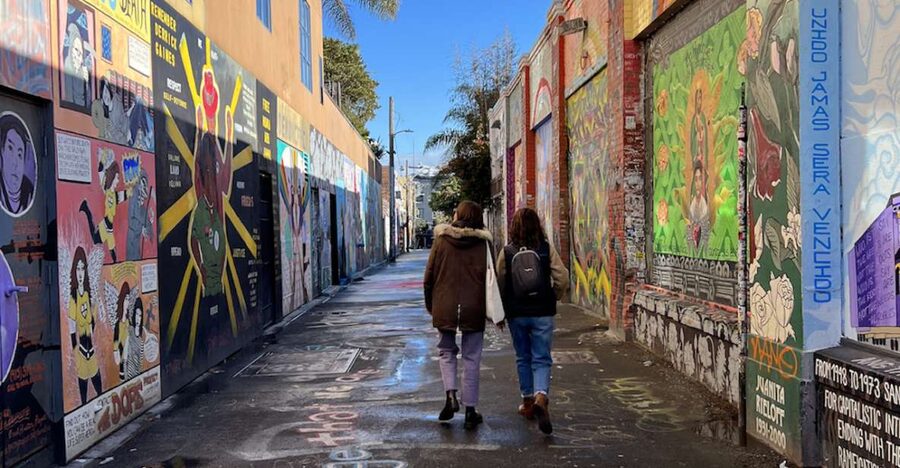
Next, you head to Valencia Street in the Mission District. This is where the tour becomes more “you are living here now” than “you are sightseeing.” The guide guides you to the kinds of shops you can miss if you only follow big-name attractions.
You will pass atypical local boutiques, plus practical options for a snack or light meal: Mexican taquerias, thrift shops, and independent bookstores. The mix is why this neighborhood feels different. It is not one single theme. It is everyday SF in a concentrated strip.
Value tip: since beverages are not included, this is a great place to grab something small if you need it. Also, the timing usually works well because you already saw the art and architecture, so you are more likely to buy something you actually care about, not just souvenir fatigue.
Liberty Hill architecture: cottages, Victorian styles, and the John McMullen House
After Valencia, the tour includes the Liberty Hill District, described as San Francisco’s first suburb. This is a smart choice because many first-time tours skip the in-between zones where architecture shifts.
Here, the focus is on variety: from simpler cottages to Victorian mansions, including homes that date to the late 19th century. The stop at the John McMullen House is highlighted as an especially striking example. Even if you do not get a deep architectural lecture, you learn how to notice what makes one block feel older than another.
I like this part because it slows the pace in your head. The Castro and Mission sections are story-heavy and visually intense. Liberty Hill brings you back to structure. You start to see San Francisco as a place that grew through different waves, not just a set of photo locations.
Dolores Park finale: the view that ties Castro and Mission together
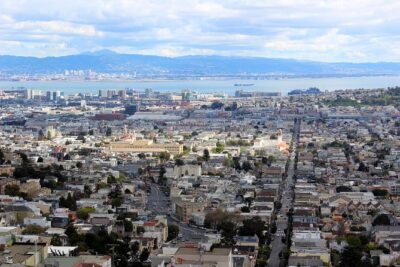
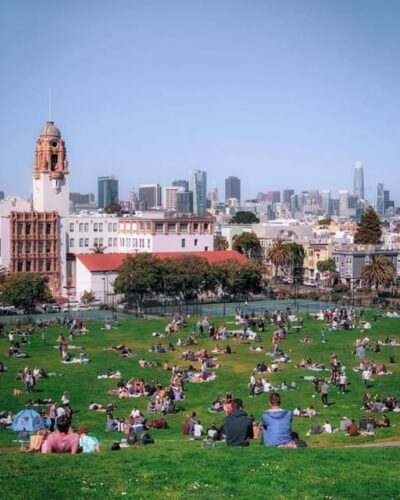
Your tour ends at Mission Dolores Park, and specifically with the stop at the top for city views. This is the payoff you want after walking: you get a wide view that shows how the neighborhoods sit inside the larger city.
From up there, you can see distant downtown skyscrapers, and that helps your brain connect the tour points. The Castro and Mission no longer feel like two separate worlds. They start to look like parts of the same city, shaped by different communities and different eras.
Practical advice: Dolores Park can have wind. Bring a layer even if the morning feels mild, because the temperature can shift fast with the marine air.
Price and value at $65: what you get for a half-day of walking
At $65 per person for about 3 hours, this tour is priced like a solid guided experience, not a cheap “stand here and read the plaque” stroll. You are paying for a French-speaking guide, a structured route across two neighborhoods, and built-in support materials like a map and a follow-up email with a reminder and a souvenir photo.
The value also comes from group size. With only up to 10 people, the guide can keep explanations clear and answer questions without repeating the same thing for 30 faces. That matters on a history-plus-streets tour, where small details help a lot.
What is not included is simple: beverages and personal purchases. If you want water or a snack, plan to buy it on your own. Also, because it is rain or shine, come prepared so the weather does not drain your energy.
Potential mismatch: if you only care about one topic, like strictly architecture or strictly political history, the balance might feel like it is splitting your focus. The tour is designed to cover both neighborhoods as living parts of the same city story.
Who this tour fits best, and who should choose another option
This works especially well if you:
- Speak French or want a guided way to learn about San Francisco in French
- Want a first pass through the Castro and Mission District without doing everything solo
- Like street-level history and street art, not only museums
- Travel with kids and want a guide who can keep explanations friendly and clear, like the guide Jeremy described in past experiences
If you prefer super-structured museum time, or you want a fully self-paced audio tour where you can linger indefinitely, this may feel like it moves at the pace of a group. But if you want a smart overview that you can build on later, it is a strong choice.
Should you book the San Francisco Mission and Castro tour in French?
Book it if you want two neighborhoods in one go, with a French-speaking guide who ties the streets to the stories. The Castro portion gives you LGBT landmark context, and the Mission portion gives you Mission Dolores, murals, and real neighborhood browsing on Valencia.
Skip it if you do not walk well, you hate rain-day plans, or you only want one narrow interest area. Also, if you do not speak French at all, this is not the best starting point, since the tour is explicitly French.
If you are aiming for value, clarity, and a route that helps you actually understand what you are seeing, this is the kind of tour that makes your next day in San Francisco easier.
FAQ
How long is the Mission and Castro districts tour in French?
The tour lasts 3 hours, with Castro and the Mission District each covered for about 1.5 hours.
Where does the tour start and where does it end?
It starts at Cafe de Casa and finishes at Mission Dolores Park.
What language is the guide?
The guide speaks French.
How large is the group?
The group is small, limited to up to 10 participants.
Does the tour run in bad weather?
Yes. The tour takes place rain or shine.
What is included in the price?
You get a French-speaking guide, a map of the visited places with best addresses, and an email after the visit with a reminder and a souvenir photo.
Are beverages included?
No. Beverages are not included.
What is the cancellation policy?
Free cancellation is available up to 24 hours in advance for a full refund.
More Tour Reviews in San Francisco
- Muir Woods and Sausalito (Return by Bus or Ferry)★ 4.5 · 5,098 reviews
- Big Bus SF: Hop-on Hop-off Tour with 17 Stops and Sunset Option★ 4.0 · 4,539 reviews
- Napa and Sonoma Wine Country Full-Day Tour from San Francisco★ 4.5 · 4,455 reviews
- Small Group Yosemite and Giant Sequoias Day Trip from San Francisco★ 5.0 · 3,671 reviews
- San Francisco: Golden Gate Bay Cruise★ 4.7 · 3,644 reviews
- San Francisco: Hop-On Hop-Off Sightseeing Tour with 17 Stops★ 4.5 · 3,600 reviews
The Castro’s Living History
- San Francisco LGBTQ Walking Tour with Local Guide★ 5.0 · 600 reviews
- San Francisco Urban Hike: Castro and Twin Peaks★ 5.0 · 71 reviews
- San Francisco Castro Mission Loop Tour★ 5.0 · 12 reviews
- San Francisco: Castro District LGBTQ+ History Tour★ 5.0 · 9 reviews
- Castro District LGBTQ+ Historic Tour★ 5.0 · 9 reviews
- Castro District LGBTQ+ History Tour★ 5.0 · 5 reviews
Murals and Taquerias in the Mission
- Mission District Food Tour: Appetizers, Entrée and Dessert★ 5.0 · 182 reviews
- San Francisco: Mission District Food Tour with 6 Tastings★ 4.9 · 104 reviews
- Mission District Food Tour★ 5.0 · 69 reviews
- Mission District Food and Culture Walking Tour★ 4.5 · 47 reviews
- San Francisco: Mission District Walking Food Tour★ 4.8 · 22 reviews
- Mission 18th Street San Francisco Food Tour★ 4.5 · 15 reviews
Fresh arrivals for a San Francisco itinerary
- San Francisco: Tour De San Francisco (Electric Bike Tour)
★ 4.7 · 3 reviews - Private Exploration of the Birds of San Francisco
★ 5.0 · 4 reviews - Zion, Bryce, Antelope, Grand Canyon, Las Vegas 6-Day Tour from SF
★ 5.0 · 3 reviews - Private Tour of Yosemite a Two Day Exploration
★ 5.0 · 4 reviews - The Presidio: Main Post to the Golden Gate Bridge
★ 5.0 · 3 reviews - Alcatraz Island Tour with San Francisco Bay Tour
★ 3.5 · 4 reviews
More ways into Castro History & LGBTQ+ Walks
 ★ 5.0San Francisco LGBTQ Walking Tour with Local GuideFrom $40600 reviews
 ★ 5.0Castro LGBTQ Walking TourFrom $4090 reviews
 ★ 5.0San Francisco Urban Hike: Castro and Twin Peaks71 reviews
 ★ 5.0San Francisco Castro Mission Loop TourFrom $6512 reviews
 ★ 5.0Castro District LGBTQ+ History TourFrom $399 reviews
 ★ 5.0Castro District LGBTQ+ Historic TourFrom $399 reviews
 ★ 5.0Castro District LGBTQ+ History TourFrom $395 reviews
 ★ 4.0Castro & LGBTQ Private Walking TourFrom $1004 reviews
Try another angle on the same itinerary